"Taking the Waters"
at Soap Lake,
a personal experience
by Sheri Decker
posted November 2002
Sheri Decker, NPF Deputy CEO,
treated her psoriasis at Soap Lake, Wash., June 21 through June 28,
2002, and prepared the following narrative.
Friday, June 21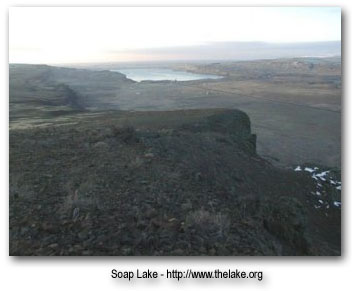
The five-hour drive from
Portland, Ore., to Soap Lake, Wash., is majestic. The tree-packed
Columbia River Gorge gives way to treeless bluffs that spill into
rolling wheat fields that stray to a dry, rocky desert terrain. Here you
find Soap Lake, both the town and the lake, located nearly in the middle
of Washington State 1,075 feet above sea level. The community of Soap
Lake is around 1,200. There’s no McDonald’s, Safeway or Best
Western; just peace and quiet and an abundance of sunshine in the summer
months and a highly mineralized lake overflowing with history and
therapeutic promise.
Soap Lake’s curative appeal
is legendary, according to the Soap Lake Conservancy, a nonprofit
organization involved in the preservation of the lake. In the early
1900s, Soap Lake was famous for its spas and resorts where tourists came
to "take the waters." It is best known for the successful
treatment of Buergers Disease, but skin, circulatory, digestive and
joint problems were commonly treated as well. Countless people still use
the healing qualities of Soap Lake mineral water and mud to treat skin
conditions such as psoriasis and psoriatic arthritis.
I arrive in Soap Lake later
than I anticipate because I always get lost in the maze of freeways that
converge where the Columbia River makes a left-hand turn into the
Tri-City area of the State of Washington. It would seem a simple
transition but for some reason what the signs say and the roads do are
two completely different concepts. This is my fourth trip to Soap Lake
following this same route and this year, before reaching this juncture,
I vow to be acutely alert and maneuver the transition from one freeway
to another with proficiency. Sadly, it is my fourth trip unearthing a
way to recover from getting lost, once again, in this baffling mass of
roads/freeways that reminds me of a winter’s ball of hibernating
snakes!
It is hot and sunny when I
arrive in the afternoon and my room at the Notaras Lodge is ready and
waiting. The lodge, which is located in the middle of town and on the
lake’s shore, is touted as "luxury in logs," and it is! Each
of its 15 rooms is decorated around a different person or theme and
furnished with artifacts, memorabilia, log beds and a bidet. Not one
detail is overlooked including a kitchenette for $65 to $125 per night.
I’m here to treat my guttate
psoriasis, which mostly envelops my legs and arms. The lesions are
slightly raised and a little inflamed, with modest scale. I entertain
visions of dramatic improvement after a week of using the mud, water and
sun therapy available at this unique site.
The treatment at Soap Lake is
do-it-yourself and consists of applying the mud, which supposedly draws
toxins from the skin, soaking in the lake water and sunbathing. I’m
welcomed my first day to weather in the high 80s and a soothing gentle
breeze. My initial task is to locate some mud. Locals tell me to walk in
the water, which is crystal clear, until my feet detect a slimy, soft
difference from the usual sandy/rocky lake bottom. If what you scoop up
stinks and is slimy, you’ve found the "good stuff "!
After my first day of therapy,
I’m off to John’s grocery store to buy food for the week. I have the
only room at the Notaras Lodge that has a full kitchen, so I plan on
eating in, though there is a wonderful restaurant across the street
called Don’s, which I’ll try later in the week. John’s is the only
grocery store in town and I purchase not only food but also a throwaway
camera to document my visions, the biggest bottle of baby oil I can find
and a bucket to store my mud.
Saturday, June 22
I’m up early to attend the
Soap Lake Science Lecture held at the local high school and sponsored by
the Soap Lake Conservancy, the organization that works to protect this
12,000-year-old natural resource for future generations and help the
area recover economically. The speakers this morning serve as Fellows of
the Science Advisory Board for the Soap Lake Conservancy. They provide
independent advice and counsel on matters of science to the Conservancy
and are chosen from academic institutions in the Pacific Northwest based
on their research interest in, and knowledge of, Soap Lake. The meeting
agenda:
Soap Lake Limnology*:
Dr. Anthony Gabriel, Asst. Professor, Central Washington University, and
Dr. Leo Bodersteiner, Asst. Professor, Western Washington University
*limnology: the scientific
study of inland waters
Natural History of Soap Lake:
Francis Jensen, Soap Lake Conservancy
Pollution Remediation in Soap
Lake: Dr. Brent Peyton,
Asst. Professor, Washington State University
There are approximately 40
people in attendance and the lectures are laden with scientific jargon.
Nonetheless, the information is captivating. Soap Lake is situated in a
majestic setting at the end of the Grand Coulee, a huge canyon created
by catastrophic Ice Age floods and the historical importance of the Ice
Age floods is obvious with regard to understanding the area’s geology.
The lake is both stratified chemically (meromictic) and thermally. The
water is four times more saline than seawater. Studies are now being
conducted on the therapeutic value of the water, especially with regard
to infection.
One of the most interesting
findings concerns the discovery of new organisms in the water that have
never been classified previously. It is being discovered that these new
bacteria are capable of cleaning up the toxic wastes created by
industries such as pharmaceuticals, hide processing and the oil
industry. Soap Lake organisms are effective in degrading pesticides and
fertilizers, for example. In fact, the National Science Foundation
recently awarded an $840,000 three-year grant to the Fellows of the
Conservancy’s Science Advisory Board to establish a Microbial
Observatory at Soap Lake to further this research.
After the three-hour lecture, I
am invited to Dr. Sigrid Penrod’s home for lunch in honor of the
morning’s speakers. Sigrid is a naturopathic physician from the
Seattle area who also practices in Soap Lake three days per month.
Sigrid sees a handful of people
who have psoriasis at Soap Lake and she reports positive results with
her treatment regimen. She prescribes supplements, a little homeopathy,
soaking in the Soap Lake water for at least 30-minutes per day, but not
longer than an hour (I forgot to find out why no longer than an hour),
and especially testing for allergies. She believes the patients’
positive results are probably due to the attention given to allergy
therapy.
I also get to know Lynn Wilson
who is involved with the conservancy and offers support by putting on
their scientific programs. She is president of a company called
Strategies, Partnerships and Conflict Resolution located in Tumwater,
Wash. Stan, her significant other, has something to do with the beef
industry and cooks up a wonderful slab of meat for the luncheon. Clark
Mather, Central Washington Director for Senator Maria Cantwell, arrives
for lunch as well and we discuss the NPF and its work.
That afternoon, I get to the
lake for treatment. I haven’t located any mud yet and I ask people
where they found theirs. No one is very helpful until I approach a man
whom I discover can’t speak English – most of the people on the
beach are speaking Russian – but he quickly deciphers my inquiry. He
motions for me to follow and we walk through the water for quite a
distance. Finally, he dives under the water and comes up with handfuls
of black slimy mud. He gives it to me and says in broken English
"God bless you." "No," I say, "God bless
YOU!" I was not very successful in locating mud and his help was
invaluable. I return to shore to slather my legs and arms with mud. It
dries in about a half hour. It stinks but you feel as though this is the
price you pay for a "cure."
Sunday, June 23
This morning it is overcast and
it doesn’t appear as though the clouds will give way to the sun. I
take the opportunity to read, write and rest. Sigrid calls and invites
me to go on a hike in the desert later in the day. I’m happy to have
something to do, though hiking in the desert sounds demanding.
Soap Lake is very quiet early
in the morning. There are no cars on the streets. No people moving
about, just the birds singing their songs. I find myself reacting to the
change in pace. I wonder what I would be like if I lived here. Would I
be calmer and less stressed? Or would I be antsy and moody because there
wasn’t enough to do? It is entertaining to ponder the possibilities.
Sigrid and I walk to the
deserted Boy Scout camp, a camp supported once by a very wealthy man who
had a ranch at the top of the bluff overlooking Soap Lake. We follow a
trail around the west end of the lake and though the sun finally came
out, the breeze keeps the heat down. On our return, we encounter a
friend of Sigrid’s bathing in the water. She lives in Seattle and owns
a home in Soap Lake as well. She spends time here during the summer
growing organic garlic and tomatoes.
My arms and legs have been in
the sun during our hike and while talking to Sigrid’s friend, I’m
thinking I need to get in the water today and time is running out. I
decide to go in with my clothes on. Everyone thinks that’s a little
peculiar but I don’t share my zeal to clear my skin. Besides, it’s
hot enough I know my clothes will be dry before I return to my temporary
home.
I learn from Sigrid and her
friend that Soap Lake residents are divided on how to preserve and/or
develop the area. Some want to preserve the lake because it is one of
the 11 meromictic lakes in the US. Others want to promote recreational
use of the lake with motorized boats, which according to some would
compromise the lake waters. Local politics are complicated and I don’t
feel I understand all that is going on.
Monday, June 24
This morning I visit the McKay
Health Clinics where Sigrid has her office and pick up her brochure.
Then I drive the 17 miles to the Moses Lake airport. The airport is new
(1998). It is modern with lots of glass, open and airy but eerie because
I am the only person in the building. Finally a ticket agent appears to
see if I could be helped, but when she learns I’m not going anywhere,
she disappears once again. The sign posted on the ticket counter says,
"We will be right back. We are outside servicing your plane."
There are three Seattle flights
and one Spokane flight posted on the board for arrival and departure
Monday through Friday. No flights are scheduled for Saturday or Sunday.
I wait for a flight from Seattle to arrive and watch four passengers
deplane. Budget and Practical car rental agencies are present but no
agents are available. Once the Seattle flight arrives someone appears at
the Budget desk. It probably depends on reservations if someone is
available to provide help.
I have a very difficult time
trying to find out how someone gets from the airport to Soap Lake. A
Soap Lake local tells me the Notaras Lodge will have someone pick you
up. A Notaras Lodge employee tells me they are thinking about purchasing
a limo for that purpose, but, so far, it isn’t part of their
operation. Soap Lake has a taxi service and there is the Grant County
Transit bus service, but I’ve no idea how one would coordinate
utilizing this form of transportation.
By car, Soap Lake is about 180
miles east of Seattle, 120 miles west of Spokane and 300 miles west and
north of Portland.
My daily routine quickly
settles into arriving at the beach around 11 a.m., coating my arms and
legs with mud, reading until the mud dries (half hour), entering the
water, washing off the mud and soaking in the water for at least a half
hour or more, returning to the beach and sunbathing for 45 minutes to an
hour. Then, back to my room, take a shower and apply oil to my skin.
The beach is never crowded and
I don’t feel out of place or uncomfortable because of Soap Lake’s
well-known reputation for healing people like me. I do not encounter
anyone else who has psoriasis but talk to one person who has eczema and
one with arthritis. We share enthusiasm for our venture to Soap Lake.
I spend the rest of the day
driving north out of Ephrata up to highway 22 and over to the Grand
Coulee Dam. The drive takes you through magnificent country. The wheat
fields stretch to the horizon, rugged bluffs overlook irrigated farmland
and huge lakes shimmer in the sunlight. It is fascinating countryside
because of the Ice Age floods and I wish I had someone to share it with.
After three days, my psoriasis
is extremely inflamed and appears to be flattening and spreading. I itch
and my skin hurts, which is not the norm. If I didn’t know from past
experience that climatotherapy (the use of sun and water to treat
psoriasis) makes my psoriasis worse before it improves, I would be
extremely anxious. There’s no guarantee, but I have faith I have riled
the beast and will continue the battle.
Tuesday, June 25
This morning I went for a
therapeutic massage. Dr. Penrod suggested that I do this and highly
recommended Kathy Jess, a Reiki Master and massage therapist, whose
office is located in the Notaras Lodge. Her fee is $40 to $60 –
whatever you think it is worth. I give her $60. After she finishes, she
advises me to drink a lot of water to flush the toxins and wastes broken
loose from my body.
She asks if I would like to
join her for dinner in Grant County’s seat Ephrata, a town six miles
from Soap Lake with a population of 6,808. Ephrata does have a McDonald’s,
Safeway and Best Western. She wants to share with me her favorite
Vietnamese restaurant, Mammy Yum Yum. I take her up on her offer and
meet her at 4 p.m. The food is great and we top off our early dinner
with a frozen yogurt from a local drive through.
On our return to Soap Lake,
Kathy points out west beach, which she believes is nicer and sandier
than the beach in front of the Notaras Lodge. She also says nude
sunbathing is easy to find on the west side of the lake, but warns to be
careful because it’s rattlesnake country. Thankfully, I have little
need of baring it all. The rattlesnakes are more than likely thankful
too.
She says that no one has to
worry about crime or being accosted in Soap Lake. The locals hassle one
another but not strangers. I feel quite safe in Soap Lake.
Wednesday, June 26
The TV weather person says it
will be a scorcher today; maybe a record breaker. By noon, the
temperature reaches 100 and ties the 1925 record.
The beach is mostly unpopulated
except for children and a few adults. A mud-coated man who is soaking in
the water tells me he has eczema and discovered some excellent mud. The
slimiest and smelliest he’s seen. He shares its location. Fortunately,
I have mud left from last Saturday. Though it is hot, the wonderful
always-present breeze washes over your skin and makes the afternoon
enjoyable.
The sign on the town’s main
drag says "Don’s Restaurant, World Famous" and something
world famous would be a welcome break from my in-room cooking over the
past few days. I’m off to Don’s for dinner and it is wonderful. The
menu is loaded with tempting selections and it’s difficult to choose.
I highly recommend Don’s.
Thursday, June 27
This is the last day of my stay
and my psoriasis is enormously "angry." The lesions are very
diffuse and inflamed. Any type of oil is necessary to keep the skin
flexible. This is the only day I omit the mud, needing a break from the
gunk, odor and dryness I presume it creates. Though my skin is sore, I
remain convinced this is a necessary process to see improvement.
Friday, June 28
I’m packed and ready to hit
the road early. I look forward to some company. I regret not being more
adventurous and seeing the laser light show staged on the walls of the
Grand Coulee Dam every night after dark or finding the Indian casino to
try my luck, but both are a 50-60 mile drive to the north and I wasn’t
bold enough to go by myself after dark. I would have liked to explore
more of Ephrata and its restaurants and entertainment spots, but the
lack of company held me back.
I don’t look forward to the
labyrinth of thoroughfares I will encounter when I get to the Tri-Cities
on my way home, but, once again, I vow to be exceptionally attentive.
Epilogue
A week after returning to
Portland, my psoriasis fades into an "almost" remission –
unobvious, very pale lesions with no scaling or itching. I am pleased
with my result and sure that with several more weeks I would have a
complete remission. And finally, I’m happy to report, I skirted
through the Tri-City freeway system without a hitch! I am dually
victorious.
Resources:
Notaras Lodge
P.O. Box 987
Soap Lake, WA 98851
(509) 246-0462
Web Site: www.notaraslodge.com
Dr. Sigrid Penrod, Naturopathic
Physician
Soap Lake Office
Toll-Free (888) 248-6692
Soap Lake Conservancy
P.O. Box 65
Soap Lake, WA 98851
(509) 766-1699
E-mail [email protected]
Web Site: www.thelake.org
Minerals found in Soap Lake
water:
Sodium
Bicarbonate
Sulfate
Carbonate
Chloride
Potassium
Organic Nitrogen
Fluoride
Ortho-Phosphate
Nitrate
Calcium
Magnesium
Trace amounts of: Aluminum,
Iron, Copper, Rubidium, Lithium, Strontium, Barium, Chromium, Lead,
Manganese, Titanium, Vanadium and Boron
Contents
www.flakehq.com | 