|
Chapter Nine
The Flaking Way of Life
“Manic Itching a.k.a. Pruritus”
In August of 1993 I was flaring mightily. Of seventy some
lesions I could count on my body, all but a handful were
raging (my forehead and nose were, thankfully, more or less
under control). I left trails of flakes everywhere I went.
Unfortunately, that same month, I and a colleague of mine
had to make a joint presentation at an industry trade show
in Washington, DC. “That's all right,” I thought to myself.
“Wear the shower cap for a week before the show; apply the
unguents two times a day; you'll be wearing a suit — only
the hands pose a problem.”
My colleague flew to my home in Kentucky about four days
ahead of the trade show. We prepared our presentation there
and planned to drive to DC. My colleague, whose career is
largely based on standing up in front of groups, suggested
that we “perfect” our dog and pony show by videotaping it a
few times then analyzing the videotapes. So I set up the
camera on a tripod, flipped it into record, and we went
through the motions, which had him working at an easel on
stage right, me moving around or standing behind a podium at
stage left.
When we reviewed the tape for the first time, I was pretty
pleased. No major screw up in delivery; overheads were
legible and seemed paced appropriately; my colleague's
performance at the easel was as smooth as I expected it to
be; my smiles and one liners seemed well timed. We sat in
silence, watching the video and taking it all in.
“What did you think of my performance?” my ever-diplomatic
colleague asked when the video concluded.
I
wracked my brain to think of something to criticize (that
was, after all, the purpose of this exercise). Finally, I
said, “Your hands look fat on the big screen when you place
the overheads on the projector.”
He didn't miss a beat. “I'll try to keep them out of the
picture next time. Did you notice anything about your
gestures?”
“My what?”
“Your gestures.”
I
thought fast again. What was I doing? Using my bird finger
to point? Grabbing my crotch like Michael Jackson? He
answered for me.
“You're scratching yourself constantly.”
I
had been totally unaware of it. I rewound the video so I
could see this myself. And yes, there I was, scratching my
scalp, my arms, my chest, my back, and my thighs. All it
seems I didn't do is raise my knee, or bend over, so I could
scratch my calves. I even saw myself scratching my buttocks.
I looked like some gorillas and baboons I've observed doing
the same thing at the zoo.
An occasional scratch, especially of one's forehead or
cheek, is considered a contemplative behavior. Psoriasis
can, on the other hand, bring on what might best be
described as “manic scratching.” This is considered
eccentric ... no ... repulsive behavior — even more so when
the consequence is a circle of flakes on the floor
surrounding you.
It's been written that some psoriatics don't have a problem
with itching. All I can say is the only lesions on my body
that have never itched are in my inner ears (even the
ones in my outer ears have itched from time to time).
The most helpful advice I've ever received from a derm about
controlling the itch was simply “Don't scratch the lesions;
it will only make them worse.” The prognosis seems to be
correct in my case, but the preventative is nearly
impossible. I scratch in my sleep and when awake. Nothing
I've tried prevents this behavior entirely; however, I have
made a few small discoveries.
My cat suffered from “manic scratching” for awhile. It was
so bad she was losing whole clumps of hair and then
scratching until her skin bled. (We're quite close. Do you
think this could have been ‘sympathy scratching’?) The vet
identified the root of the problem and prescribed some
concoction to take care of that, but in the meantime, to
control the cat's itch, he prescribed an over the counter
(human) antihistamine. We allergy sufferers know all about
histamines and antihistamines. Histamines are something your
body generates that, when in excess, make you itch. I
suppose back when we were filthy furry creatures this was a
natural safety measure: Itching aggravated the fleas and
other multi-legged pestilences that bear diseases and make
us irritable. Even though we eventually lost the fur (or
most of it) we kept the histamines. Histamines need
something to do, too, and have found that raging against
environmental things like pollen, dust, smoke, mold spoor,
etc., can keep them occupied. So, when we people who are
allergic to such things can't avoid them, the histamines
come out in force. Antihistamines are just that: chemical
agents that counteract the histamines.
I
tried the antihistamine treatment myself the next time I
found psoriasis related itching to be a problem and, sure
enough, obtained some relief.
As I've said, I know of no sure-fire way to get around the
itching. Antihistamines help some, but at a cost — most of
those that abate itching effectively also induce drowsiness,
so they're not always a desirable course of action. The best
long-term regimen to fight scratching appears to be keeping
your skin moist. Not just the lesions, all of your
skin. This means frequent application of a good lotion and
use of a moisturizing soap, or a soap-like cleanser that
does not have any real soap. I had a cardiologist once —
yeah, a heart doctor — offer this bit of unsolicited advice:
“You have no business using soap at all.” He told me to use
Dove
bar soap, which for nearly a decade I did. Now I'm trying
Dove Body Wash
and it seems to work even better than the Dove
bar soap.
Oh yes, our presentation at the trade show in DC went well
and I never scratched. To not scratch was foremost in my
mind during the presentation, so it's a good thing I had my
lines down pat. And my buddy kept his fat hands mostly out
of the overhead projector.
But I must confess, after our presentation I returned to my
room, stripped, and scratched until, in places, I bled. A
good thing to do? Of course not. But I would rather have
done that than had sex at that moment.
“I am food for dust mites...”
For awhile I was dating a woman who lived in another State.
Our encounters were brief and always precipitated by
circumstances beyond our lust. In other words, we were lucky
enough to find occasions to get together, usually paid for
by someone else.
I
was so excited by this one opportunity I splurged and
reserved a suite at a prestigious hotel in downtown San
Diego. Hardwood paneling, thick pile, dark ruby carpets...
Great! Just the place for a flaming psoriatic!
Scheduling complications precluded her from joining me my
first night there, so I used room service for my dinner and
spent the evening lounging in bed while watching in‑room
movies and, of course, scratching. The next morning I was
horrified. Parts of me were everywhere. That ruby red carpet
showed every flake as though it were a diamond on black
felt. Thank God the bed sheets were white; but suspecting
the worst, I wiped them off and watched a shower of flakes
deepen on the carpet surrounding the bed.
She would be joining me that afternoon. This was
unacceptable. I had to be as flake free as possible. Instead
of my usual morning shower, I opted to soak in the bathtub,
let those flakes get soft and lethargic, and then eradicate
them with a powerful terry cloth scrubbing. I went at it
with a vengeance.
When I uncorked the tub, stood up and dried myself off, I
was more ruby red than the carpet in my suite, but if there
were loose flakes on my body, I couldn't see them. All
right. I felt good. I was confident the maids would come
before my afternoon tête-à-tête, and I appeared flake free
for the time being.
The only thing I was right about was the maids. They did
come and clean the flakes out of my room before my lover
joined me there that evening. But my rough “bathtub
treatment” backfired mightily.
My current derm calls such treatments “atomic bombs.”
Psoriatic lesions are areas of the skin your body suspects
need reinforcing (i.e., these areas are under attack, but
it's not true) so your body expands the blood flow into
these areas and supercharges the skin's growth rate.
My derm says, “We try to figure out why the body can be
fooled into thinking there's a problem when there isn't one,
but treatment isn't helped when you make a problem
where there wasn't one.” Interpreted, that means my rough
removal of flakes in the bathtub that morning — working over
my lesions with the washcloth until they almost bled —
simply reinforced my body's assumption that something was
wrong. So, for the next eight hours, it stepped into high
gear to replace all those scales I'd scraped away.
Lord knows, I knew it was happening, all day long as I sat
through my business meetings. I could feel my skin grow like
Kansas farmers can hear the corn grow.
By the time I got back to the hotel, she was already there.
Flowers, champagne, room service already ordered. I stayed
in my suit, tried not to itch, for as long as I could. But
this was, after all, a romantic liaison. Finally I had to
say, “My Sweet, my psoriasis is raging. Let me go see how
bad the situation is.”
As I rose to go to the dressing room, I saw the dusting of
flakes on my black Oxford shoes.
Minutes later, she knocked on the door to the dressing room.
I was standing before the mirror, naked, totally appalled —
every lesion had rebuilt every flake I had taken away that
morning, plus some!
“Yes?” I called back to her knock, trying to sound calm.
“If you're going to bathe,” she said, seductively, “let me
join you.”
She was an extraordinarily sympathetic lover.
The next morning we laughed together and I said, “Look what
I have to put up with!” then swept flakes out of the bed
onto the ruby red carpet.
“You should always live in hotels, then,” she said, pulling
the sheet around her. “So you'll have maid service daily.”
“But it's disgusting!” I whined.
“It's job security,” she said.
“What? What do you mean?”
“You are a perpetual harvest of food for dust mites,” she
said, “And God loves dust mites, too.”
“The clothes make the man — feel better”
Before my psoriasis I had a very casual attitude about
clothes. I hated long sleeve shirts, liked Bermuda shorts,
loathed spending lots of money on “business attire.”
When I was transferred to Washington, DC, I was given an
office next to an older woman who was appalled by my lack of
taste in clothes.
One day, after we'd been together for several months, Nancy
couldn't stand me any longer. She stopped me in the hall:
“Ed, why don't you take the afternoon off and go buy a new
suit?”
“Nancy,” I said. “I'd love to take the afternoon off, but I
don't have eighty dollars to spend on a suit right now.”
This was 1980. Nancy was floored. “Eighty dollars? Ed, you
can't buy a suit for eighty dollars!”
Now I was insulted. “Nancy, I've never spent over
eighty dollars for a suit in my life. Why should a suit cost
more than eighty dollars?”
Nancy evidently sensed a window of opportunity. There, in
the hall, she launched her lecture on quality clothing. She
explained how suits are fabricated, cut, stitched
together.... About the seasonality of different fabrics, the
importance of linings.... This went on for several moments,
until my eyes glazed over and it became apparent to her that
most of what she was saying was sailing right over my head.
Chagrined, she stopped her lecture and said, “Well, Ed, how
do you judge a suit's quality?”
I
looked at her completely deadpan and said, “Nancy, it's
easy. I tug at the seams to see if they'll hold up in the
wash.”
A
year later, Nancy's and my paths separated. Since then,
every few years we run into each other at a trade show. The
last time this happened I saw Nancy before Nancy saw me. I
crept up behind her in the conference exhibit hall and
tapped her on the shoulder. “Look Nancy,” I said when she
turned, “Not a man‑made fiber on my body!” She grinned
broadly and hugged me.
“Took you long enough to catch on, Ed.”
What drove me, eventually, to quality clothing was no
epiphany of style. It was the psoriasis that did it for me.
My second wife bore the burden of years when my psoriasis
was budding. I did not associate clothes with discomfort —
itching, scratching, bleeding and flaking — but she did. She
bought my first silk shirt. What a difference that made! The
silk floated on my skin, felt almost as though I were
wearing nothing at all. It should surprise no one to learn
that if the clothes they wear irritate their skin, their
“skin problems” are going to be exacerbated.
Furthermore, I learned that most of the time garments that
feel good look good, too. Until I was forty, I don't think
anyone ever said to me, “Gosh, Ed, that's a good looking
shirt.”
One of the joys of working at home is what I call the
“Hefner Effect.” Hugh Hefner, founder of the Playboy™
empire, use to be well known for living in pajamas and
bathrobes.
When you “telecommute,” as I do, you can work all day in
your robe if you want to. Now, I don't do that normally, but
there are many days when I'll get up before sunrise and put
in an hour or two at the computer before getting dressed for
the day. When I do this it is always my worst “flake time.”
When I converted my garage into my office I made a dumb
choice in carpeting: It's blue and shows every flake. On
some of my “bathrobed” mornings I used to leave a veritable
doughnut of flakes around the chair at my workstation. This
resulted from my “manic itching.” I sat there, staring at
the computer screen, deeply engrossed, and when my fingers
weren't on the keyboard they were scratching somewhere.
This went on for a few years. It would still be going on,
but I finally wised up. It wasn't just the psoriatic
lesions begging to be scratched, it was the combination of
psoriatic lesions and my terry cloth bathrobe.
Terry cloth, especially as it gets older, tends to be very
abrasive.
The day I switched to a silk robe the pre‑dawn doughnut of
flakes quit being a problem. Thanks to my silk robe, my
vacuum cleaner can anticipate a longer life.
●●●●●
Ed’s Postscript (5/22/2008-5/27/2008):
I don’t think it would be an overstatement to say that if
you can’t control your scratching, you will never be lesion
free. I think my manic scratching had a lot to do with the
fast spread of my psoriasis in the early and mid 1990s. I
may be mistaken. I did grow some lesions that never itched
and others that may have but couldn’t be reached to scratch
(e.g., middle of my back). But interestingly, these lesions
usually weren’t medicated, yet they healed as well as others
that got gooped all the time. The lesions that I scratched
the most hardly ever improved, no matter how much goop I
drowned them under.
My scalp is a good indicator of my scratch-and-flame
theory. All my scalp lesions itch horribly. I have this one
chance to improve my scalp with prescription topicals, which
is to catch the lesion growth on my scalp early while I
still have the will power not to scratch, then apply the
topicals and leave them alone. Nine times out of ten the
scalp psoriasis subsides, or at least doesn’t get worse.
HOWEVER, if I falter and begin to scratch, a full scalp
flame time is inevitably ignited. No amount of topical goop
will overcome the damage done by scratching. This is why for
years I’d have flaming scalp psoriasis while lesions
elsewhere on my body would come and go, improve or fail to
improve under the effects of assorted topicals.
Scratching a psoriasis lesion is like tilling the soil of
your garden. It just makes it easier for your psoriasis to
grow.
A typical plaque psoriasis lesion releases flakes of
silverish or whitish scale. Each scale is a cluster of dead
skin cells from the top layer of your skin. When they are
alive, these cells are translucent and supple and live for
up to 30 days before they are displaced by new cells pushing
their way to the surface. These newer cells enjoy the life
support provided by lower levels of skin (blood flow
containing oxygen and nutrients) effectively “killing off”
the older, outer cells. In psoriatic skin, the normal
replacement of old cells by new cells happens in more like 4
days instead of the normal 20-30. The old cells can’t be
shed in a leisurely fashion; instead, they clump together as
scales and tend to hang on until environmental factors —
clothes rubbing, being bumped, abraded or scratched —
detaches the scales.
But what’s “typical” about psoriasis scale does have some
interesting variety associated with different parts of the
body. The scalp is one of these exceptional
scale-generating places. The scale doesn’t form that much
differently than it does in other places, but the density of
hair up there makes the result different.
I wager there’s not one among us that hasn’t experienced
the exercise of wrestling a “chunk” of psoriasis off a
strand of hair. For one, the natural oils exuded from hair
follicles mixes with the dead skin tissue to form a thicker,
more snot-like substance. This “new” substance tends to
bunch around hairs, building up like mulch mixed with glue.
You can break these away from the scalp by scratching,
combing or brushing, but then they become loose rings of
psoriasis snot floating on hairs like shish-kabob pieces on
a barbeque skewer. For straight-haired flakers these pieces
slide off easily, but curly or kinky-haired flakers have a
tougher time with final removal. The way I’ve expressed it
here is misleadingly unpleasant. I can spend hours
meditatively deflaking my scalp. All I need is healthy
fingernails. I’ve heard from many other flakers who say the
same thing. It may be a long-forgotten animal trait that had
soothing or social value. I’ve read that chimpanzees spend
hours picking bugs out of each other’s fur. Scalp deflaking
might feel like that (stress reduction?). I’ve never tried
deflaking another flaker’s scalp, or having another flaker
deflake my scalp. But that’s not to say I won’t have the
opportunity to try it in the future.
Places on the body that tend to stay moist —
armpits, groin, skin “folds” — are less likely to form the
dry scale associated with plaque psoriasis. In fact, they
have another name for the type of psoriasis that manifests
in these areas: inverse.
I’ve also heard it referred to as
“flexural” psoriasis. When inverse lesions
itch, WATCH
OUT. Scratching these lesions can result in burn-like pain
that isn’t immediate. This is particularly insidious because
you scratch and the kind of pain that actually “feels good”
and abates itching occurs for a time, so you tend to keep
scratching. Then, some minutes later, the burning starts.
The longer you scratched, the worse it is.
My worst inverse P is on my scrotum and around my scrotum
in the groin area. I’ve learned the hard way about the
post-scratching agony. These days, when I happen to catch
one of those old Michael Jackson music videos with his
trademark crotch-grabbing gesture, I don’t grin or giggle, I
wince and writhe.
Another unique psoriasis scaling experience is reserved
for people who have “inny” type navels (bellybuttons). Two
pictures of flakes in the navel are contained at
ShockingPsoriasis.com and a glimpse of these may help
you understand what I’m about to say.
If the navel
is deep, as mine is, and flakes are actually generated
inside
the aperture, as mine are, the most unique thing happens at
the very bottom of the navel: the flakes ball up and become
compacted and attached to the healthy skin. This psoriasis
ball must be pried loose (I use medical forceps). I call
what I pull out of my navel this way a “kernel,” because it
reminds me of an unpopped popcorn kernel. Recognizing that
one has a P-kernel deep in one’s navel, then going through
the procedure of removing it, is without a doubt for me one
of the most rewarding activities provided by this obnoxious
disease. I have no idea why this is so. Is it a perversion?
If so, judge me not until you have pried your own kernel
from your navel and understand the satisfaction....
But by far the most startling story about “manic” removal
of flakes (now that we’ve moved on from simple scratching)
had to come from Mike
B., whom I interviewed in July, 2007. I quote....
I'd always assumed
that the buildup under my heels, and to a lesser extent
the rest of my feet, was simply years of accumulated
callus, since I've always preferred to go around
barefoot at home. During my hospitalizations for
erythrodermic psoriasis, years of psoriasis build-up on
the bottoms of my feet cracked. I'm not sure if the
cracks were caused by the erythro flares, or the
treatment, or both or neither. Anyway, those large
cracks opened almost the entire length of my feet, from
the back of the heel to just behind the toes.
I conned my wife
into helping me enlarge this crack with a pair of thin
barber-style scissors, and at that point we were able to
peel the whole thing off in almost one piece, like some
kind of monstrous sock. Getting it over the toes was
very uncomfortable, borderline-painful, but the results
were amazing. It was many weeks before I got even a
hint of fresh scaling there.
But the usual foot
treatment involves working on the thickest chunks with
the serrated knife. What the heck, while I get uneven
chunks off, it does (for a while) encourage new
semi-loose edges that I can play with. –Mike B.,
FlakeHQ Interview
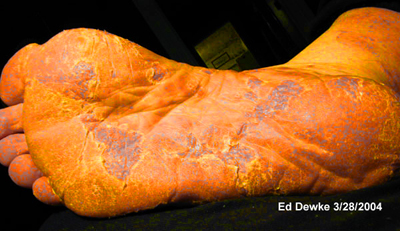 My
feet have been just about as bad as Mike B.’s depiction.
Here’s a photograph of the sole of one of my feet when it
was very bad. I’ve saturated some of the colors to add
contrast for easier viewing. The “yellow” is psoriatic skin
— the type Mike peeled off like some “monstrous sock.” My
feet have been just about as bad as Mike B.’s depiction.
Here’s a photograph of the sole of one of my feet when it
was very bad. I’ve saturated some of the colors to add
contrast for easier viewing. The “yellow” is psoriatic skin
— the type Mike peeled off like some “monstrous sock.”
The tendency to want to peel one’s psoriatic feet (and
“peeling” is, truly the right word to describe the process)
is, in my opinion, related to scratching. In my case, it was
the distinctive kind of itch generated by foot lesions that
lead me to discover they CAN be peeled. Once I made that
discovery, I was hooked as long as there were lesions active
on my feet. I have one “piece” of psoriasis from my foot in
a desk drawer. I shaped it to
make a mandolin pick and put it there to “age” thinking it
would get tougher but retain some flexibility. I looked
forward to eventually using it as a mandolin pick. Years
have gone by and I haven’t used the “flake pick” to play
mandolin. I fear it has become too rigid. It will either
break if I try to strum with it, or it will play but not
“sound right.” I’ve decided, though, not to throw it away.
It isn’t bothering anything in my desk drawer. I take it out
sometimes and remember how long it’s been since my feet had
such atrocious lesions on them. That is a good thing to be
reminded of.
A couple of additional things to read about “itching”...
●●●
It’s been a long time, now, since I’ve left piles of
flakes everywhere I go. I must make myself stop and remember
how awful that used to be. The experience recounted here — a
romantic tēte-â-tēte — pains me to recollect and makes me
completely sympathetic to the intimacy anxieties suffered by
any flaker. Having said that, I’ve received tons of email
from people recounting how understanding their lovers have
been. I would say this email outweighs its opposite 10 to 1.
There are, however, disparities between female and male
experiences.
Most of the email I’ve received on the subject from male
flakers has reported understanding partners. Most of the
email from female flakers has also reported positive
experiences, but the anxieties leading up to those positive
experiences have been longer and harder.
My favorite recent story is from M.G. It started in
early 2006 and ran through the fall of 2007. In this order,
M.G.’s story is a terrific and inspiring read:
Another story came from Gene R. as a response to M.G.’s
first chapter (Can’t Let a Boyfriend Get Close). It’s a male
point of view with an interesting twist:
●●●
That clothes can aggravate or mitigate one’s experience
of living with psoriasis is a fact as far as I’m concerned.
Since I wrote the final section of this original chapter in
the early 1990s, I’ve learned that even the detergent I use
to wash my clothes and the softening “sheets” I use in my
dryer can make a difference. (For me, all these products
need to be allergen-free.)
Another side of the “dressing for psoriasis” experience
is fashion and style. How many emails have I received over
the past dozen years from upset folks who couldn’t wear what
they wanted to wear?
For the psoriatic, the style and color of clothing is
often determined — at least in part — by how many lesions
can be covered, and how flakes can be made inconspicuous.
For women this often means slacks and pastel colored
long-sleeve blouses, sweaters and jackets. Men have less
difficulty “dressing for psoriasis” because styles in
business and formal attire usually “cover up” most of their
skin. Both sexes have trouble with leisure and “activity”
styles. And, when psoriasis lands on the hands, face and
scalp, dressing to conceal is hopeless.
I’ve heard from a number of flakers who
staunchly advocate doing nothing to conceal one’s psoriasis.
Dress as you would like, they
say, and if people have problems with what they see let
them look away.
Sometimes I experience this attitude as
courageous resolve. None of us “are” what our skin might
suggest we are (monstrous ...
diseased ... grotesque....), so to be exposed and
disprove that we are these awful things is a good,
admirable act. But I have occasionally witnessed it being
not so admirable. I’ve seen mean people with bad tempers
flaunt their psoriasis in ways intended to be
off-putting. It is as if they are saying, Back off,
people, I AM an ogre, as you can see.
On those rare occasions when I run across
this type of flaker, it makes me recoil and want all the
more to hide my lesions from society.
Last year (2007),
Mike Paranzino, founder and publisher of Psoriasis Cure
Now!, organized national “Short Sleeve Day” (September 15,
2007). This year it is “Short Sleeve Days” (plural,
September 12-14, 2008). Mike is skillfully playing off the
passion we all have to be treated as “normal,” to be able to
“dress like the rest” without inhibition or qualm.
Over the years there have been a number of similar
attempts to “free us” from our dressing constraints by
grouping us together. Cruises for flakers have been
recommended. Later this year (2008), at the National
Psoriasis Foundation annual meeting in Orlando, a “pool
party” is being arranged. All of these opportunities
underscore our natural desire to have skin we can expose
with impunity.
The flipside of our compunction is to cover
up with style. A telling example is the recent reception
given to Viri Elena at PsorChat
when she suggested she and some friends are considering
starting a line of clothing for flakers. If you could equate
enthusiastic replies on a message board as “applause,” you’d
have to conclude Viri Elena’s idea drew a standing ovation.
(To review the correspondence, search on Viri Elena at
PsorChat.)
Appearances, and our subservience to them,
are hardwired into us. We can overcome this social
programming if we really want to, but we do
not want to. Rather
than lose or cover up our psoriasis lesions, is there anyone
who would rather lesions come "into style?” I didn’t think
so.
●
Contents of
Flake: Confessions... |
 May-June
'08 | briefing |
mail | interviews
| articles |
psorchat
| psorchat review |
don't
say this |
flaker
creativity | flakers' jargon |
other
places | archives | send
mail | ed dewke | search |
acknowledgments
| flake: confessions... | legal
stuff
| ©2008 Ed
Dewke
May-June
'08 | briefing |
mail | interviews
| articles |
psorchat
| psorchat review |
don't
say this |
flaker
creativity | flakers' jargon |
other
places | archives | send
mail | ed dewke | search |
acknowledgments
| flake: confessions... | legal
stuff
| ©2008 Ed
Dewke
