The First Stage
 It
never occurred to me in August 2002 when I had my first meeting with
Gail Zimmerman, President and CEO of the National Psoriasis
Foundation, that some four years later we'd be having drinks
together on a weekday night at 11 PM in places like Dallas, Los
Angeles, Portland, San Francisco and New York. The ways of the world
are sometimes strange, sometimes unexpected.
It
never occurred to me in August 2002 when I had my first meeting with
Gail Zimmerman, President and CEO of the National Psoriasis
Foundation, that some four years later we'd be having drinks
together on a weekday night at 11 PM in places like Dallas, Los
Angeles, Portland, San Francisco and New York. The ways of the world
are sometimes strange, sometimes unexpected.
For it was on that day in August that I first presented to Gail the
idea that had been percolating inside me for over twenty years —
that it was important, no, that it was ESSENTIAL, that someone
create a film about the impact of psoriasis and psoriatic arthritis
on the individual who lives with these conditions on a daily basis.
And so the first question I asked her was the availability of
material on the subject — what, I wanted to know, had already been
done to focus on these illnesses from the perspective of the
emotional and psychosocial areas of life? Where in her video
library were the films/videos that helped clarify the profound
impact that P and PA have on so many of us? What could I draw on,
and possibly reference, that would help me to direct a work of
meaning and importance, not just for myself (my harshest critic),
but for the community at large? The answer, my friend, was blowin'
in the wind. For better (or worse), there was nothing to be found.
Leaving the offices of the
Foundation that day, I was filled with a sense of purpose and a
realization that it would be me who would actually create this
moving-image document that has come to define so much of my life
over the last four years. And of course I would have no way of
knowing in what directions I would venture forth, what cities I
would visit, and what lives I would touch on my journey. And now
that I've traveled to nine cities (eight of these with the
Foundation, and one, Grand Rapids, Michigan, on my own), I've met
some 400 people, many with psoriasis and psoriatic arthritis, and
many connected to these folks through either marriage, partnership
or friendship.
The Big Splash
In September, 2005, with the film complete and “in the can,” I was
flown off to New York City by Genentech, the principal sponsor of
the film. This would be my “Hollywood-style” debut, and I had better
enjoy it! I was put up in fancy hotel, wined and dined, and along
with Dr. Mark Lebwohl, a leading dermatologist in New York,
conducted a series of radio interviews. Mark also appears in the
film and has been a tremendous advocate for the Foundation and its
members. The screening was held at the Tribeca Film Center in
Manhattan, the facility founded by Robert De Niro and a host to its
own film festival. Over fifty invited guests attended, including my
family, and it felt very much like a “coming out” of sorts, a cross
between a film premiere and my Bar Mitzvah! Everything went
smoothly, yet I was so nervous and excited that over the next few
nights I barely slept at all.
In the audience was Mike Laub, a wonderfully generous and
compassionate man who is active in the Foundation and its Capital
Campaign. He immediately saw the potential to utilize the film as
an educational outreach and fundraising tool. Four weeks later, he
flew me back to New York and arranged for the film to be shown at a
Fundraising Event that he organized for the Foundation. People,
friends of his who knew little about the disease, were quite taken
by the film. Many called the next day and told him how powerful the
work was and what an impact it had on them! Both Mike and I knew
that this was the beginning of an important opportunity to bring the
important messages of the film to as wide an audience as possible.
Over the next four months or so, the Foundation, spearheaded by
Development Director Terri King, began formulating plans to bring
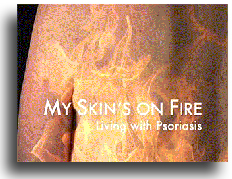
My Skin’s On Fire to its own members. The “Road Show” was
forming to visit select cities, with myself, Terri King, and Gail
Zimmerman in tow, reaching out to Foundation members and their
families and friends, and hoping the film might motivate people to
reach beyond themselves and contribute to the mission and mandates
of the Foundation. And with my face now on the cover of The
Advance, the national magazine published by the Foundation, a
real buzz was starting to circulate the message boards. And my
interview on this
venerable web site was about to appear. By the time people actually
began receiving copies of the film (March, '06) the word on the
street was quite positive. People were “aglow,” and now was the
time to strike while the iron was hot!
The Next Step
We needed an anchor. All of us — especially Gail, Mike, and Terri —
knew that a mechanism needed to be in place in order to draw
Foundation members where we took the show. The Support Groups were
the natural magnets to attract our audience. After all, a city with
a strong Support Group in place has a built-in audience that is
eager for information; they also have a direct line to local
dermatologists, derm nurses and others in the extended psoriasis
family — including, of course, actual family members!
And while the task of approaching the Support Groups was organized
by Terri, and the travel arrangements made by Eve-Maridy Rice, it
fell on me to decide how to present myself to the Groups. How
would I would I introduce myself AND my film, which is both a part
of me and distinct from me, an organism unto itself that impacts
people in ways both dramatic and subtle. I decided to say as
little as possible (not an easy task!), and to follow the dictum
that “a picture is worth a thousand words.” And so we started the
DVD player, sat back, and let it unfold.
The Aftermath
There's always a pregnant moment after the final credit rolls by and
the lights come up. And while every audience is different — just
ask any stage actor — I've observed that the feeling in the room is
often quite strong. People, mostly those with psoriasis and
psoriatic arthritis, especially if they've just seen the film for
the first time, are deeply affected. Sometimes you can even hear a
sniffle or two, and spot an eye that is filled with tears. In these
moments I never really know what to say, and perhaps not saying
anything is best. Of course there are times, fortunately not very
often, when an audience merely applauds — and there's nothing else.
I recall one city where there was no audible reaction throughout the
entire film — not even a chuckle during the humorous sequences. Are
these people comatose, I wondered?
When people do speak, which is the rule, I've felt as if I've really
made a difference in the lives of these folks and their partners. In
Portland, a man approached me afterwards and confided that in the
ten years he was married to his wife (who has the illness), this was
the FIRST time that he really began to understand what she goes
through on a daily basis. I was stunned. It's inconceivable to me
that someone who sleeps next to someone every night for ten years is
not deeply impacted by their partner's condition, especially a
condition so visible and disturbing. It made me wonder about the
very nature of relationships — or at least THIS relationship, and
what it took to create a shift of consciousness, so to speak.
In Los Angeles, just as I
was about to say something after the film, a man leapt up, ran up to
the front of the room and took the microphone. He then took off his
shirt, which revealed a chest and back completely covered with
plaque lesions. He then told us of the tragedy of his marriage and
of his wife's unwillingness to share a bed anymore. He converted our
audience into a 5-minute Support Group: it was simultaneously sad
and utterly beautiful.
What these events tell me
is that My Skin's on Fire has given people permission
to access feelings they were either unaware of or too uncomfortable
to share publicly. By exposing myself, literally, I somehow opened
the door for others to step forward and proclaim their illness
before themselves and their families. A wise teacher once told me
the act of embracing one's vulnerability allows one to step into his
or her strongest self. For me, creating this film has given me the
strength to do just that. It somehow liberated me from the shackles
of my own self-loathing and negation. And of course I hope that
others who continue to see the film, either in the context of their
home or in a group setting, will also feel a sense of validation and
acceptance. And perhaps they'll look at this short, skinny guy from
New York and realize that all of us with moderate to severe illness,
no matter what we look like to the outside world, understand each
other oh so well. And we all know that understanding dispels myth
and leads to greater awareness.
The Future
With eight “official” cities under our belts, and 'Walk for
Awareness' committees now forming to organize for community outreach
and fund raising, the road show has left an impression on
communities around the country. We still have at least two more
screenings — one in Aventura, Florida (near Miami), on September 12.
And one in another city, probably on the West coast, yet to be
determined. Am I pleased with this act of outreach and community
education? Yes and no. Yes, because I'm facilitating the
transmission of an important human story to members of the community
where that story has unfolded. And no, because not enough people
have seen the film and I won't be satisfied until many more do.
So I'm working to get the word out about My Skin’s On Fire
while seeking sources of funding that will enable me to continue
to visit other cities and connect with more people in our
community. After seeing the film, I hope that folks will acknowledge
the parts of ourselves that are both visibly affected by psoriasis
and also invisibly affected.
I'm a very fortunate man,
and over the next year I want to continue to share my film with as
many people as possible. -FF
P.S. - I am pleased to
report that On July 15, Portland held the first 'Walk for Awareness'
for psoriasis and over $13,000 was raised for the National Psoriasis
Foundation. -FF
 Sep-Oct
'06 | briefing |
mail | interviews
| articles |
psorchat
| psorchat review |
don't
say this |
flaker
creativity | flakers' jargon |
other
places | archives | send
mail | ed dewke | search |
acknowledgments
| legal
stuff
| ©2004 Ed
Dewke
Sep-Oct
'06 | briefing |
mail | interviews
| articles |
psorchat
| psorchat review |
don't
say this |
flaker
creativity | flakers' jargon |
other
places | archives | send
mail | ed dewke | search |
acknowledgments
| legal
stuff
| ©2004 Ed
Dewke